How to Be With Yourself When You Are in a Core Wound
Core wounds are uniquely difficult. Sheira shares her personal experience of being inside a core wound and what helped her come through it.
Articles, Podcasts & Research
This article explores how certain practices within OA may inadvertently reinforce the eating disorder rather than facilitate healing, and offers insights into what truly creates lasting recovery.
Read the Full ArticleIn this podcast, healer/teachers Sheira Kahn and Diana Zaheer invite you inside their friendship to give you an experience of connection you can take to your close relationships. With 11 episodes, you will leave with tools you can use - even during a fight.
The Id - the animal and child part of human nature - is quite misunderstood and much maligned! Explore how to integrate the id so its vitality and energy becomes available to you.
Getting into your body and the present moment to overcome the tyrannical inner critic, with tools to move through the trauma behind it.
Diet thoughts can be a response to underlying feelings, and an invitation to explore what's really going on - and find your power angle in different situations.
Core wounds are uniquely difficult. Sheira shares her personal experience of being inside a core wound and what helped her come through it.
Core wounds are not like normal wounds. How the usual tools fail there, how to recognize the state, and how deep, steady presence helps.
The inner critic feels true because it works through your nervous system. Why the alarm in your body is real but the message usually isn't.
Hurting each other is inevitable; repair isn't. Why pulling back after a fight hurts more — and what a real repair conversation sounds like.
Most fights start with a distorted interpretation, not the event itself. A simple timeline exercise to check your interpretations before the rabbit hole.
Depletion and deprivation are at the heart of most eating problems. Why the part of you that wants food may be asking to be loved — and a blessing that gives something back.
Learn the difference between plain hunger and the 'red zone' of too hungry — and a simple exercise to read your body's signals.
A simple way to start rebuilding trust with your body — beginning with a greeting.
Lasting eating disorder recovery comes from shifting to an inner focus. Why GLP-1s, surgery, and nutrition rules can only activate the wisdom that was already inside you.
When overeating feels automatic, it may be because your identity and your habit agree. On how the inner critic shapes behavior — and how metaprocessing can help.
Meditation isn't only the cushion. Swimming, dancing, live music, and real contact with another person can drop the nervous system into the same meditative state.
Taking up space is not taking over the space. Moving out of merging with the people you love — without cutting off — by monitoring your own energy.
How objectivity — seeing thoughts about weight, calories, and hunger as constructs rather than facts — frees a client in anorexia recovery from the binge-restrict cycle.
On staying grounded in your own corner without merging — noticing fear, releasing control, and letting awareness widen to include a loved one.
GLP-1 recovery isn't just weight loss. Lasting eating disorder recovery requires metaprocessing, a new brain map, and self-acceptance.
Yes, there are guidelines, but there is no one right way to heal. Three women, three paths — and why there isn't one correct map for recovery.
On how the anger that surfaces when we start paying attention to ourselves is often a sign of healing — and how to slow it down.
What being triggered does to the brain — and why you can't trust what anyone says while they're in that state.
On Freud's forgotten teaching about the id as the pipeline of the life force, the inner critic as a misfiring warning system, and how to welcome the muse back in.
On how early gaps in attunement shape who we are, why people with similar wounds find each other, and how to tend to the unmet places within.
How the inner critic's harshness drives the unproductivity it punishes — and how to shift from command to cooperation.
An excerpt of Chapter Three from The Erasing Ed Treatment Manual
A practical guide to reconnecting with your body's hunger and fullness signals.
Concrete responses you can use to challenge and quiet your harshest self-judgments.
Guidance for parents navigating a child's eating disorder—what helps, what hurts, and how to stay connected.
A comprehensive introduction to the types, causes, and treatment approaches for eating disorders.
Addressing the often-overlooked reality of eating disorders in men and how to seek help.
Exploring the connection between eating disorders and fertility, and the path toward healing both.
Clinical insights on treating anorexia through attachment, the inner critic, and emotional expression.
How expressing emotions directly reduces eating disorder compulsivity and creates healing through corrective experiences.
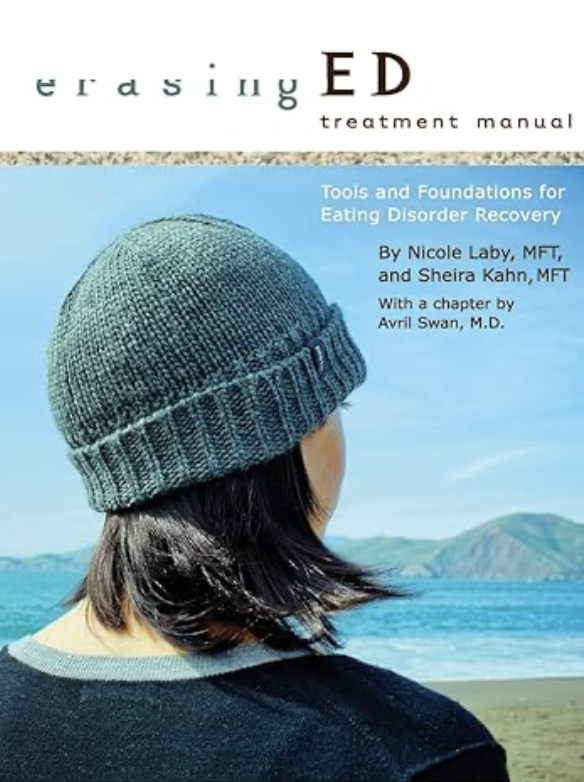
Tools and Foundations for Eating Disorder Recovery
A companion to the award-winning PBS documentary, this treatment manual provides accessible, clear guidance on the assessment, diagnosis, and treatment of eating disorders—written for mental health providers and non-professionals alike.
"Writing and teaching are extensions of my therapeutic work—ways to reach and help more people on their healing journeys."
— Sheira Kahn
